
Enterprise AI Sovereignty: Surviving the Off-Switch
Updated: Jun 22
Engineering European AI Operations to Survive a Withdrawal No Enterprise Can Prevent

On Friday, 12 June 2026, acting under a United States export-control directive, Anthropic abruptly disabled access to its two most advanced systems, Fable 5 and Mythos 5. The directive barred access by any foreign national — including those inside the United States and the company's own non-citizen staff — and because nationality could not be segmented at the interface, the models went dark for every customer worldwide, American enterprises included. At the G7 summit in Évian-les-Bains days later, a United States–led "trusted partners" framework opened a negotiated path back, but on a timeline and an approval list no enterprise controls. For European leaders, the decisive lesson is not that access was lost, nor when it might return. It is that access could be lost at all: a capability that cost billions to build, and on which whole business models now depend, was withdrawn by a single decision in a capital where European firms hold no vote. The strategic response is therefore not to lobby for restoration. Enterprise AI sovereignty, properly understood, is the capacity to ensure the business never again depends on a single provider it does not control — through a model-agnostic architecture, a tested bench of European and open-weight alternatives, and a board that can state the precise cost of losing access.
When a Utility Becomes a Privilege
For the better part of two years, European businesses have treated access to the world's most capable artificial intelligence much as they treat electricity or cloud computing — as a utility. You pay for it, you build on top of it, and you assume it will be there in the morning. That the most advanced systems happened to be American felt like a detail of geography rather than a point of strategic exposure.
On Friday, 12 June 2026, that assumption collapsed. Acting in compliance with a United States export-control directive issued by federal authorities on national-security grounds, Anthropic abruptly disabled access to its two most powerful systems, Fable 5 and Mythos 5. The detail that matters most is the scope. The directive did not draw a line at the United States border. It barred access by any foreign national, whether inside or outside the United States, including the company's own non-citizen employees. Because that restriction could not be enforced selectively at the point of use, the practical consequence was total: the models were withdrawn from every customer, American enterprises among them. The effect inside Europe was immediate and concrete, but it was not Europe alone. Products, automated workflows, and AI agents built on those systems were, overnight, running on borrowed permission everywhere.
The trigger was narrower than the disruption it caused. The government's stated concern was not trade or sovereignty but a specific safety question: a reported method of bypassing — "jailbreaking" — the safeguards intended to limit Fable 5's use for certain cybersecurity tasks, including the identification of software vulnerabilities. Fable 5 is the guardrailed public release of the more powerful underlying Mythos model, which had previously been offered only to a limited set of approved institutions. A targeted dispute over one capability, in other words, removed an entire tier of frontier systems from the global market in a single afternoon.
At the G7 summit held in Évian-les-Bains from 15 to 17 June, that disruption became a matter of statecraft. Heads of state met alongside the Chief Executive Officers of the leading AI laboratories, and a "trusted partners" framework took shape: a managed-access scheme, advanced principally by the United States, that would allow vetted entities from allied nations to regain access to the restricted models. President Emmanuel Macron championed the approach and, on 17 June, said he expected progress within weeks. The details remain to be settled. The eventual shape, scope, and timing of any restored access are, at the time of writing, unresolved — and, critically, they sit on a United States–controlled approval list rather than on any timetable a European enterprise can influence.
The instinct across European boardrooms has been to wait this out, and on the surface the reasoning is sound. These models cost their makers hundreds of millions, in some cases billions, to train, and that investment can be recovered only by selling into global markets. Forfeiting access is commercially self-defeating, and commercial pressure, the argument runs, will force a reversal within weeks. This is the comfortable reading. It is also mistaken, for two connected reasons.
The first concerns reliability. The commercial logic that supposedly guarantees a reversal — that no producer willingly forfeits its largest markets — was fully visible before the restriction was imposed, and the restriction was imposed nonetheless. That sequence is itself the signal worth planning around. It establishes that access is being governed by considerations that operate on a different logic and timetable than commercial incentive — regulatory, security, and geopolitical factors that lie wholly outside any customer's control. A dependency exposed to that category of variable cannot be assumed to unwind on a predictable schedule. Nor is there any assurance that restored access, when it comes, returns in a form useful to mid-sized enterprises rather than one gated, through a vetting process, to large or strategically favoured institutions.
The second reason matters more, because it holds regardless of what happens next. Access may return within days, within months, or never; the timeline sits outside any European enterprise's control and is not the point. Reinstating access would not undo what the episode has already revealed — that any capability resting on a single foundation that can be withdrawn by a party outside the enterprise's control is a liability wearing the costume of an asset. The precedent, once set, does not expire when the restriction lifts. Consequently, a business that simply waits for the switch to flip back and then resumes as before has recovered nothing. It has merely reset the clock until the next disruption, while learning none of the lesson the first one offered. The enterprises that emerge from this stronger are those that treat June not as an interruption to be endured but as the disclosure of a permanent risk — and that re-architect accordingly.
It is worth dwelling on why this is structural rather than a matter of European misfortune. American enterprises lost access on the same afternoon and for the same reason. No firm was singled out; the entire tier was removed by a decision internal to one government's policy process. For a European business, that decision was made in a capital where it has no representation, by a process to which it is a bystander, and the negotiated route back runs through that same government's allow-list. The exposure, correctly understood, is not "Europe was severed." It is that frontier capability can be governed by a sovereign authority no customer controls — and that the cost of that governance falls on whoever built their operations on top of it.
Reading the Market the Directive Created
To see why substitution is a hedge rather than a sacrifice, it helps to picture the landscape the restriction has produced. The decisive exhibit plots frontier capability, measured against the enterprise's own production workloads, on the vertical axis against access-sovereignty risk on the horizontal, with each live option positioned as a point: the restricted American frontier systems, the frontier models of competing American laboratories, Mistral's European stack, and the leading open-weight checkpoints that any organization can run on its own hardware.
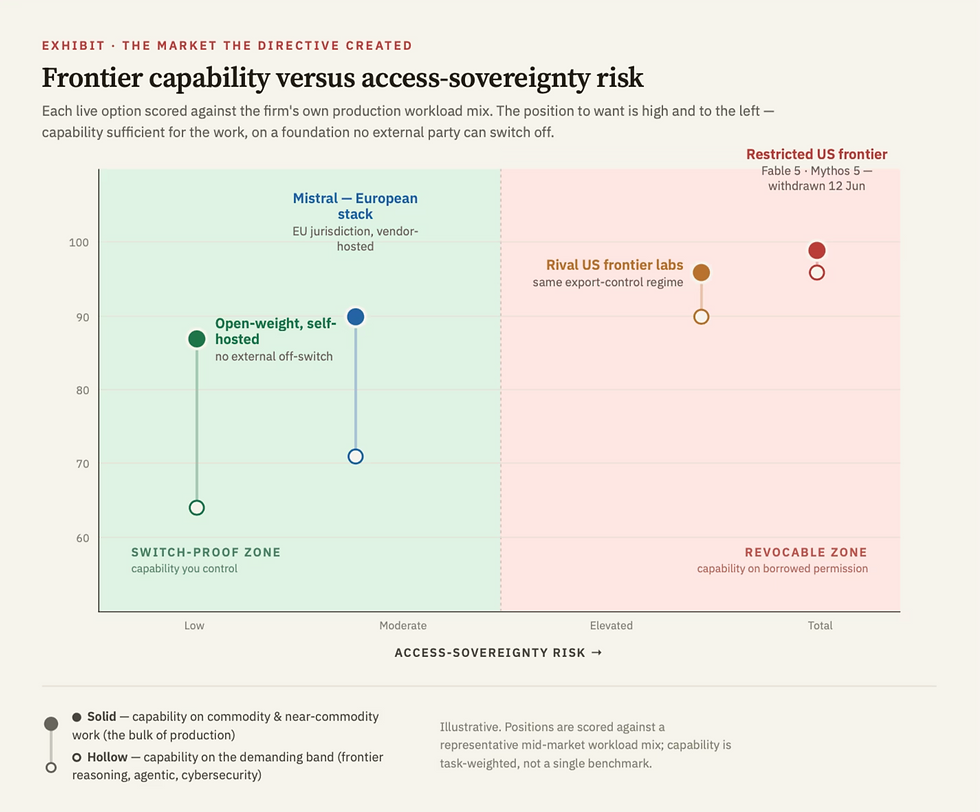
The pattern the chart exposes is the heart of the strategic case, but its force depends on a distinction the headline numbers obscure: capability is not a single quantity. For the bulk of enterprise production work — document extraction, classification, routing, retrieval, drafting, and summarization — open-weight and European models operate at or near parity with the restricted frontier, frequently within a single-digit accuracy delta when measured on a firm's own tasks. For a narrower and more demanding band — frontier reasoning, complex multi-step agentic workflows, and advanced cybersecurity work — the gap is real and can be substantial.
The strategically correct question is therefore not "what fraction of the frontier can I retain by substituting downward?" but "what fraction of my own workload runs acceptably on an alternative no external party can switch off?" For most enterprises, that fraction is the large majority. Plotted against that workload-specific measure, the switch-proof options sit in the low-risk quadrant with only a modest capability surrender for the work that actually constitutes the business. Read plainly, the firms refusing to substitute on commodity and near-commodity workloads are paying a sovereign risk premium that is total in order to retain a capability margin that, for those workloads, is marginal. The exception — the demanding band where the gap is genuine — is precisely where a firm should reason explicitly about whether the irreplaceable capability is worth the unhedged dependency, rather than assume the question away in either direction.
Architecting for Revocability
The chart describes the problem; converting it into a defensible operating posture requires discipline. That discipline rests on three pillars, applied in sequence, each of which severs a different strand of the dependency between the enterprise's capability and a foreign government's permission.
1. Sever the Hard-Wire. The foundational failure across European AI estates is direct integration — application logic that calls one specific model's interface by name, binding the firm's operational capability to that single vendor's continued availability. The first pillar replaces this with a model-agnostic orchestration layer, an internal abstraction through which every request is routed so that no application knows, or needs to know, whether it is being served by an American frontier model, by Mistral, or by an open-weight model running in the firm's own datacenter. Consequently, when access is withdrawn, substitution becomes a change to a routing table executed in hours rather than a re-engineering programme executed over quarters.
2. Validate the Bench. An abstraction layer with nothing proven behind it is theatre, which is why the second pillar mandates a standing bench of qualified alternatives — including at least one European option such as Mistral and at least one self-hostable open-weight model that no external party can switch off. Crucially, these are not held in untested reserve. Each is run against the enterprise's own evaluation harness, measuring task accuracy, latency, and cost on the workloads that matter, so that the capability delta of any switch is a known quantity rather than a discovery made in the middle of a crisis. In this way the bench converts revocation from an existential shock into a pre-priced operational contingency.
The bench, however, is not free, and pretending otherwise weakens the case. Continuous benchmarking consumes inference budget, and maintaining multiple live integrations carries a standing engineering cost. The correct level of redundancy is therefore itself a decision, priced against the blast radius established by the third pillar: a workload whose loss would halt revenue-critical operations warrants a fully warm, continuously validated fallback, while one that could tolerate a day of degradation does not justify the same expenditure. Optionality is purchased deliberately and in proportion, not maximised reflexively.
3. Price the Off-Switch. The final pillar lifts the question out of the technology function and places it where it belongs, in front of the board. The enterprise executes a formal revocation drill: it simulates the immediate loss of its primary frontier model and measures the actual blast radius — which products degrade, which agents halt, what migration costs in engineering hours and in lost capability, and which workloads fall in the demanding band where no current alternative closes the gap. This exercise converts an abstract geopolitical anxiety into a single defensible figure. A board able to state precisely what the loss of its primary model would cost, and how quickly and completely the bench would absorb it, has priced the sovereign variable that its competitors are still pretending does not exist.
What the Architecture Buys: An Illustrative Case
To see what this is worth in practice, consider one example in two scenarios. It is a composite — built to represent the mid-market engagements we see rather than one audited client — so the figures are illustrative rather than exact.
Scenario A — the status quo. A European mid-market logistics firm ran two workflows, customer routing and document extraction, on a single American frontier model. When the June restriction hit, almost nothing was protected. Most of its automated processing depended on a model it could suddenly no longer reach. Nothing tested stood ready to take over. And migrating in a hurry would have taken an estimated nine to twelve weeks.
Scenario B — implementing our proposal. The three pillars were applied in order. First, an abstraction layer was placed between the firm's applications and the model, so the applications no longer called the model directly. Second, a bench of alternatives was assembled — a European frontier model and a self-hosted open-weight model — and both were tested against the firm's own benchmarks. Third, the team ran a revocation drill, simulating the loss of the main model to confirm that the switch-over actually worked.
Set against Scenario A, this was a step change, not a marginal gain — and the workload is why. Routing and extraction are exactly the everyday tasks where open-weight and European models perform almost as well as the frontier. Moving to them cost only a little accuracy, comfortably good enough for the job, and at a fraction of the price. The firm's worst-case recovery time fell from nine-to-twelve weeks to a routing change measured in hours. A risk that had been neither measured nor capped became a known, bounded item on the risk register. The firm did not wait for the G7 talks at Évian; it made their outcome largely irrelevant to its operations.
One honest caveat. Had the firm's critical work fallen in the demanding band — frontier reasoning or advanced cybersecurity, where the alternatives still lag — the same exercise would have left a thinner safety margin and a harder conversation for the board. Forcing that harder conversation is exactly what the drill is for.
Three Decisions for the Board This Quarter
The lesson of June generalises beyond any single firm, and it translates into three decisions that belong on the board's agenda now — independent of how, or whether, the current restriction resolves.
Make the abstraction layer a non-negotiable standard. Reclassify direct, named-vendor model integrations as a sovereign-risk liability, reallocate engineering capital to insert a model-agnostic orchestration layer across every production workflow, and freeze new direct integrations from this quarter forward.
Fund and validate the bench in proportion to blast radius. Commission at least one European and one self-hostable open-weight model, each benchmarked against your own evaluation harness, without waiting for the current restriction to resolve. Size the redundancy to the workload: a warm, continuously validated fallback for revenue-critical paths, a lighter posture where degradation is tolerable. Treat any frontier dependency on a critical path that lacks a tested, switch-off-proof fallback as an unhedged single point of failure on the risk register.
Commission a revocation stress test and report the number. Order a formal drill simulating the loss of your primary frontier model and require a quantified blast-radius report — products affected, migration hours, capability delta, and the specific workloads where no alternative yet closes the gap — at the next board meeting. The objective is one defensible figure: the cost of the off-switch. A competitor who cannot state that figure has not managed the risk. They have only declined to look at it.
Outlook: Enterprise AI Sovereignty Is Architected, Not Granted
The events beginning on 12 June will be litigated as a policy story — who restricted what, who negotiated what back, and on which terms. For the enterprises that depend on these systems, that framing is a distraction. The policy will move; the precedent will not. Access to frontier capability has been shown to be conditional, governed by a sovereign authority no customer controls, and conditional access is a design parameter, not a passing news cycle.
Consequently, the organizations that emerge ahead will not be those holding the most powerful model or the warmest relationship with a single laboratory. They will be those that engineered the freedom to be indifferent to either — able to route around a withdrawal in hours, absorb it within a known capability band, and price it to the board with precision. The deeper shift is one of ownership: sovereignty over an enterprise's own AI capability is no longer conferred by a vendor or secured by a treaty. It is architected, deliberately, by the enterprise itself — and the work of architecting it begins before the next withdrawal, not after.
Key Takeaways
Treat access as conditional by default. Frontier AI capability proved revocable on 12 June 2026 — withdrawn from every customer, including American enterprises, by a government in which European firms hold no vote. Any strategy that assumes uninterrupted access to a single provider now carries an unpriced liability on the balance sheet.
Architect for substitution, not restoration. The durable response is a model-agnostic abstraction layer paired with a pre-validated bench of European and open-weight alternatives — sized in proportion to each workload's blast radius, and recognising that those alternatives reach near-parity on the bulk of enterprise work while a genuine gap persists on the most demanding tasks. It is not a wait for a diplomatic resolution that runs through a foreign government's approval list.
Price the off-switch at the board. Run a formal revocation drill and report a single figure — what losing the primary model costs in migration hours and capability, and which workloads no alternative can yet cover. A risk that is not quantified is a risk that is not managed, and the reallocation of capital toward optionality should not wait on any external timetable.


Comments