
Germany Has Industrial Knowledge to Put to Work
The discussion at Kraftwerk Berlin connected AI development with the expertise of German businesses. In its report of the discussion, NVIDIA quotes Chancellor Merz highlighting the Mittelstand's strength and encouraging companies to put their data to use with AI. The same report quotes Mr Huang emphasising the value of Germany's industrial knowledge and AI's potential to augment it. The reception on 19 October preceded the summit's main programme at ESMT Berlin on 20 October. 123
For manufacturers, this knowledge is part of everyday work. Engineers understand how materials behave, inspectors recognise defects and production teams know why a sequence works. Drawings and machine records capture some of that expertise; the people who interpret them explain what the records mean. Bringing both into an AI project gives the team a way to connect technical development with the process it wants to improve.
That is the business opportunity we see in the exchange. A manufacturer can identify where its expertise would help an AI system perform useful work, then bring engineers, process owners and technology providers together to test it. Deciding how to use and protect that knowledge belongs in the same conversation.
NVIDIA defines physical AI as systems that perceive, understand and act in the physical world, supported by tools such as simulation and synthetic training data. For a plant manager, the value of those tools must become visible in familiar measures: less time preparing an inspection, for example, or a better production schedule tested before it reaches the line. Quality and safety remain conditions of success. 4
The summit's recognition of industrial knowledge is therefore a constructive starting point. Manufacturers have specific problems to bring to AI development, and the initiative announced alongside the summit offers a way to involve them.

The Initiative Provides a Starting Point
According to the government's announcement, the Federal Ministry for Economic Affairs and Energy and the Federal Ministry for Research, Technology and Space signed a Joint Declaration of Intent with NVIDIA in connection with the summit. The announcement describes specialised industrial AI models that would draw on NVIDIA model families such as Nemotron and Cosmos, alongside German industrial data and engineering expertise. Plattform Industrie 4.0 is to play a central role, with research institutions, industry and smaller companies involved in the initiative. 5
Relevant computing infrastructure predates the summit. Deutsche Telekom reports that its Munich Industrial AI Cloud has operated since February 2026 with around 10,000 NVIDIA Blackwell GPUs. The initiative could draw on existing industrial AI capacity, but the government announcement does not establish a role for this cloud. 6
However, the public announcement leaves important commercial questions unanswered: how much funding is available, when the initiative will deliver and on what terms companies can participate. We have not located or reviewed the signed declaration. The announcement alone cannot establish what the full agreement contains, and the existence of computing infrastructure does not settle access terms for an individual manufacturer.
Companies can still prepare while those questions are resolved. They can select a process, organise the relevant data and seek proposals from providers. An investment that depends on public support or future capacity must make that dependency explicit. Preparing the business case can begin now; any commitment that relies on particular initiative terms must remain conditional until those terms are confirmed.
EXHIBIT 1 · FROM ANNOUNCEMENT TO ACTION
Match each opportunity to the next practical step
What the reviewed sources establish about the initiative and related capabilities, checked 21 October 2026, and what a company should verify before proceeding.
- Established in the sources reviewed
- Not established in the sources reviewed, or not reviewed
| ITEM | STATED INTENT | PUBLISHED TERMS | OPERATIONAL NOW | NEXT STEP FOR A FIRM |
|---|---|---|---|---|
| Joint Declaration of Intent BMWE, BMFTR and NVIDIA, signed in connection with the summit, 19 Oct 2026 | Established in the sources reviewed: Yes Specialised industrial AI models on German data and engineering expertise | Not established in the sources reviewed, or not reviewed: Not established in the sources reviewed Funding, timetable and access terms; declaration text not located | Not established in the sources reviewed, or not reviewed: Not a service Intention announced; operational programme not established in the reviewed sources | Name an owner; re-assess when terms are published |
| Plattform Industrie 4.0 Named by the government as central to the initiative | Established in the sources reviewed: Yes Central role; research, industry and smaller firms to be involved | Not established in the sources reviewed, or not reviewed: Not established in the sources reviewed Participation route for the initiative | Established in the sources reviewed: Network exists Refocused on industrial AI, Jul 2026 | Use its use-case and interoperability work |
| Industrial AI Cloud, Munich Deutsche Telekom; ~10,000 GPUs (company figures). Related infrastructure | Not established in the sources reviewed, or not reviewed: Role in initiative not established Not named in the government announcement | Not established in the sources reviewed, or not reviewed: Not reviewed Prices and terms for smaller firms | Established in the sources reviewed: Operating Since Feb 2026, per Telekom (Jun 2026) | Request terms; test with one defined workload |
| Nemotron, Cosmos models NVIDIA model families named by the government as examples for the planned models | Established in the sources reviewed: Named as a basis Joint industrial models still to be developed | Established in the sources reviewed: Nemotron licence published Dec 2025 version reviewed; Cosmos licence text not reviewed | Established in the sources reviewed: Some variants available Open-weight releases per NVIDIA, 21 Oct 2026; availability of joint models not established | Legal review of the licence for each model variant |
| SupplyOn on Industrial AI Cloud AI sourcing service; supplier network of ~140,000 companies (company figure). Not named in the initiative | Established in the sources reviewed: Announced Jun 2026 (Telekom); further agents planned | Not established in the sources reviewed, or not reviewed: Not reviewed Commercial terms | Not established in the sources reviewed, or not reviewed: Not established in the sources reviewed Current availability per firm | Ask whether your supplier network is in scope |
Editorial analysis; not a ranking
Sources: Federal Government announcement (19 Oct 2026); NVIDIA Blog (19 and 21 Oct 2026); Deutsche Telekom (18 Jun 2026); BMWE/BMFTR on Plattform Industrie 4.0 (3 Jul 2026); NVIDIA Nemotron Open Model License (15 Dec 2025); NVIDIA Cosmos announcement (Jan 2025). Company figures and availability are as stated by the companies, not independently tested. “Not established in the sources reviewed”: evidence is missing from what was checked. “Not reviewed”: the document or commercial term was not checked. The signed declaration was not located or reviewed. Sources checked 21 October 2026.
Start Where the Factory Can Measure the Difference
Inspection and production planning offer concrete starting points. At Siemens' Erlangen electronics plant, virtual preparation for inspecting new circuit-board assemblies can reduce engineering effort by up to 85%, according to Siemens. The company separately reports potential cost savings of up to 20% from agent-based production planning. These figures concern different workflows and describe company-stated potential. They are not independently verified returns that another factory can assume. 7
In the inspection example, a digital twin provides a virtual model from which synthetic images can be produced to train an inspection system before physical prototypes are available. Engineers can test whether this method shortens preparation while preserving the required detection quality. That gives them two measures to judge together: the effort saved and the quality of the inspection.
Production planning applies simulation to decisions about the line itself. In its report on Erlangen, NVIDIA describes an agent proposing plans, a digital twin testing them and a production controller approving changes before they reach the line. This sequence gives a manufacturer a useful model for combining automation with oversight. Adopting it would still require safety engineering and validation for the manufacturer's own process. 8
Suppliers may also encounter AI through platforms they already use. In June 2026, Deutsche Telekom announced that SupplyOn, whose network connects approximately 140,000 companies, was connecting its platform to the Industrial AI Cloud, beginning with AI-assisted sourcing. The network figure counts connected companies, not users of the new service. A supplier considering that service must establish which functions it can access, what they cost and which data it must contribute. 6
Whether a company develops a factory application or uses a shared platform, the investment should begin with work that needs improving. A measured first project can reveal both the benefit and what it takes to achieve it. Computing access is only one part of that work; people need the skills to implement the system and judge its results.
Companies Need the Skills and Clarity to Act
AI use remains uneven across company sizes. In the Federal Statistical Office's 2025 survey, 26% of enterprises with at least 10 employees reported using AI. The share was 23% among those with 10–49 employees and 57% among those with 250 or more. These are adoption figures for the surveyed enterprises, not a measure of manufacturers' readiness. Nor do employee-size classes define the Mittelstand. 9
Separate surveys help explain why some firms hesitate. Among companies that had considered AI but had not adopted it in the 2024 Destatis survey, 71% cited missing knowledge and 58% unclear legal consequences. In Bitkom's 2026 survey, 85% of non-users cited missing implementation know-how and 66% legal hurdles and uncertainty. 1011
The surveys cover different populations, periods and methods, so their percentages cannot establish a trend. Bitkom is also an industry association, and the responses describe perceived barriers rather than the measured burden of a particular law. Within those limits, both surveys identify concerns that businesses and policymakers can address: knowing how to implement AI and understanding the conditions for using it.
Companies must develop the ability to select applications, prepare data and evaluate results. Public authorities can help by making requirements and routes into the initiative clear. Investment in computing capacity becomes more useful when firms also have the skills and confidence to put it to work.
EXHIBIT 2 · AI USE IN GERMAN ENTERPRISES
Adoption differs by company size and application
Reported AI use in the Destatis 2025 survey. The size comparison covers surveyed enterprises; the application comparison covers enterprises already using AI.
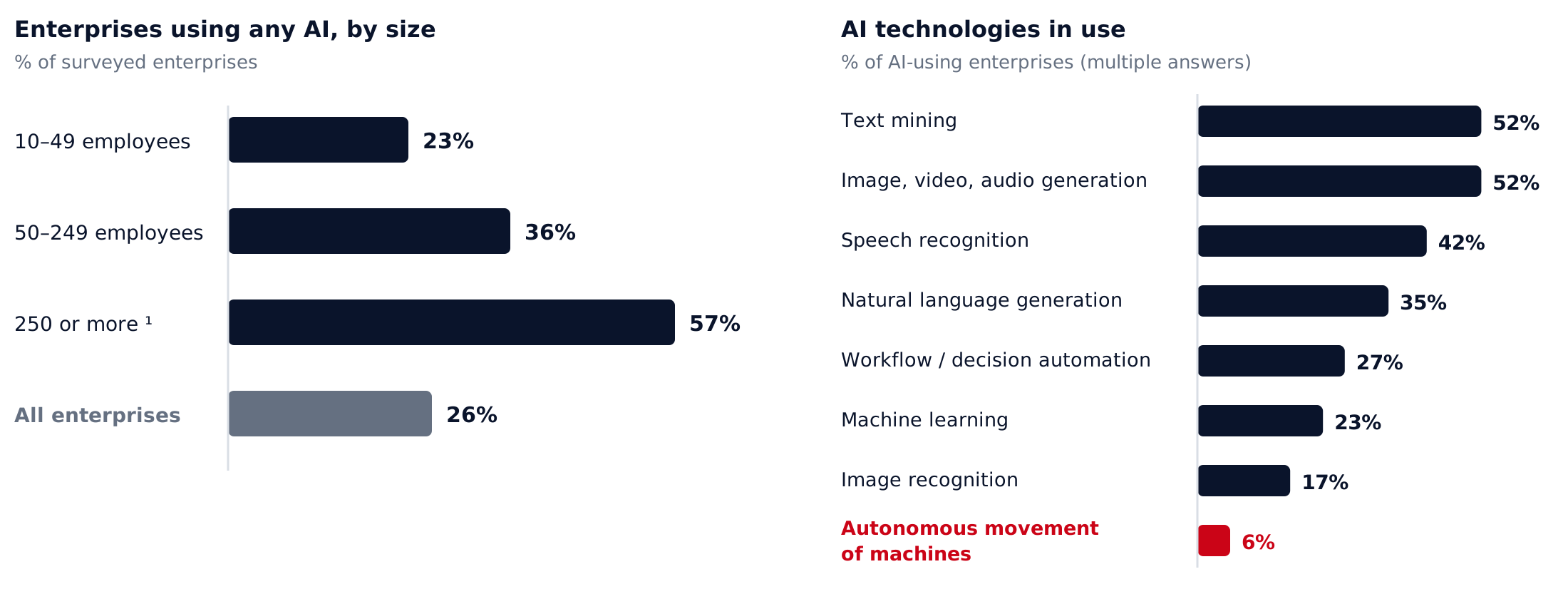
These figures measure reported use, not readiness. Autonomous machine movement is only part of physical AI. The enterprise definition changed in 2025.
Source: Statistisches Bundesamt (Destatis), “Unternehmen mit Nutzung von Technologien der künstlichen Intelligenz”, reference year 2025, as of 24 November 2025.
Voluntary survey of about 20,000 enterprises with at least 10 employees across almost all economic sectors. Applications can overlap.
¹ Destatis survey documentation defines large enterprises as 250 employees or more (“ab 250”); the table header reads “mehr als 250”.
Four Disciplines for Turning Expertise into Results
The practical challenge for management is to turn a promising application into a project the company can execute and evaluate. Four disciplines connect the operating problem to the investment decision.
1. Choose a problem worth solving.
Begin with an inspection, planning or related process and give an operating leader responsibility for improving it. Measure current performance using preparation hours, changeover time, defect detection or another measure that matters to the business. Set a target alongside the quality and safety conditions the project must meet.
The Siemens figures indicate where gains may be possible. The manufacturer's own baseline establishes what improvement would mean in its factory, allowing management to judge the proposal against its needs and later compare the result with the starting point.
2. Prepare the knowledge the task needs.
Involve the people who understand the process before deciding which data to collect. They can identify the inspection images, machine logs, quality records or design information needed, and explain the context in which those records were created. Check reliability and who can authorise their use.
Focusing on one process allows preparation to begin without waiting for an enterprise-wide data programme to finish. It also makes decisions about sharing more precise: which records are commercially sensitive, which can be provided and what restrictions must accompany them?
3. Agree how the company will retain control.
Before sharing data, agree who can access it, how it may be used and what rights the company will have to adaptations and outputs. Establish how operations would continue if the provider became unavailable. German hosting establishes where data is held; the contract and the company's practical ability to access and move its work determine other aspects of control.
Put those arrangements to a practical test. Can the company export its records and move a useful model or workflow with them, and which dependencies would remain? Establish what can be returned or deleted, including copies and backups, and how data use affects a trained model. Review model licences and service agreements separately, because one set of terms may not cover the whole arrangement.
4. Fund progress against evidence.
With the process, data and terms defined, management can approve a first stage and budget for preparation, integration, validation, training and ongoing operation. Record any dependence on future capacity or external support. Anticipated subsidies are not secured financing.
Agree when the team will return for a funding decision and what evidence it must bring. Expand when results justify it, revise when there is a credible route to improvement, and stop when the case no longer holds. Staged funding lets the company learn from operating experience before making a larger commitment.
These disciplines are most useful when applied together. A promising demonstration will tell management little about the investment if nobody has measured the existing process or established the cost and terms of continued use.
A Manufacturer’s Decision: From Demonstration to Investment
A manufacturer wants to inspect metal components faster without missing defects or rejecting good parts. It is considering an AI system that checks images of each component. This hypothetical example shows how two approaches to the same investment can lead to very different decisions.
Scenario A: buy after a convincing demonstration. A provider demonstrates the system on a selection of images, and management approves a wider rollout. However, the manufacturer has not tested it against the difficult cases its inspectors encounter or measured how it compares with the existing process. Questions about integration costs and the provider’s use of production images are left until implementation. The demonstration has shown what the technology can do, but management still cannot judge whether it will improve this factory’s performance.
Scenario B: test against the factory’s requirements. The manufacturer starts with one component type. Its inspectors select representative examples of acceptable parts and defects, including cases that are difficult to distinguish. The team measures inspection time, missed defects and unnecessary rejections, then tests the AI system alongside the existing process. Before sharing images, it agrees how the provider may use them and what the manufacturer can retain or transfer if it changes provider. Management funds a wider rollout only if the trial meets the agreed quality requirements and the expected benefit justifies the full cost.
The second approach makes the investment decision clearer. Management can see whether the system solves its production problem, what it will cost to operate and whether the company can retain control of its data and work. A successful trial supports expansion; a disappointing result gives the team a reason to revise or stop before committing more capital.
Make Responsible Adoption Easier
Preparation within the company will not answer every question. A manufacturer also needs to understand which rules apply to its proposed use, which authority is responsible for supervision and how it can test the system responsibly. Public authorities can make these decisions easier by providing clear, usable guidance.
Our policy recommendation is to develop industrial capability and proportionate safeguards together. Requirements that add complexity without corresponding protection can divert effort from deployment and safety. Predictable rules and credible oversight, meanwhile, can give companies confidence to invest. Policymakers should judge implementation by how well it enables responsible use and delivers the intended protection.
Germany has already taken steps in this direction. The Bundesnetzagentur states that the national AI Act implementing law entered into force on 29 July 2026, combining central coordination with sector authorities. Its Service Desk offers guidance and an initial risk-level estimate. That assistance can help a firm assess a proposal, but it does not provide binding approval of an application. 12
Building on those steps, policymakers should make it easier for companies to resolve the questions that affect an investment:
- Make the requirements clear. Explain which rules apply to common uses, what evidence firms need and which authority is responsible. Provide binding decisions where the law permits, alongside support for implementation skills.
- Coordinate supervision. Combine sector expertise with central AI coordination and consistent European implementation. Avoid requesting the same evidence twice without a corresponding supervisory need.
- Explain the routes to testing. State who can use regulatory sandboxes, for which applications and on what terms. Make appropriate supervised testing accessible as capacity becomes available.
- Show companies how to participate. Publish contacts, selection criteria, available resources and terms so that smaller companies can assess whether and how to join the industrial AI initiative.
The surveys point to a need for both implementation knowledge and legal clarity. Providing one without the other leaves part of the problem unresolved. Skills help a team build and evaluate a system; clear requirements help it proceed responsibly. Supporting both would make the initiative more accessible to the businesses it seeks to involve.

Three Decisions for the Board This Quarter
Boards need not wait for every detail of the initiative to decide what their own companies should begin. They can give management a clear mandate for a first project while keeping any reliance on the initiative conditional.
- Choose a process and name its owner. Select a workflow where improvement can be measured. Give an operating leader responsibility for the result and access to the expertise needed to deliver it.
- Commission the data and control review. Establish which records the project needs, who can authorise their use and which terms the company requires. Resolve material questions early enough to inform provider selection.
- Fund the first stage against evidence. Approve a defined budget, a baseline, a target and conditions for further investment. Treat external support as conditional until its terms are confirmed.
Outlook
The meeting between Chancellor Merz and Mr Huang highlighted an important opportunity: Germany's industrial businesses can bring their knowledge into AI development and test its value in the processes they know best. The initiative provides a starting point for that collaboration, while existing infrastructure and applications in inspection and planning offer practical ways to begin.
Its lasting value will emerge through decisions inside companies and public authorities. Manufacturers must choose worthwhile projects, involve the people who understand the work and expand on the strength of results. Policymakers must make participation and responsible implementation easier. Together, those actions can turn the summit's welcome ambition into improvements on the factory floor.